
US Air Force
Document AI
The AI classification, extraction, and routing engine behind an Intelligent Document Processing platform for U.S. Air Force logistics.

Jobs-to-be-Done
"When Air Force logistics documents arrive as unstructured forms, PDFs, and scanned copies, turn them into structured, system-ready data without a person transcribing each one — so requisitions, personnel actions, and maintenance records stop waiting on manual handling."
This is the core job US Air Force Document AI hired Tebeau Group to get done — the real outcome they needed, not just the deliverable they asked for.
Watch the Project
Machine Learning Data Extraction Automation Integrations
Intelligent document processing for Air Force logistics
The shape of the intelligent document processing pipeline — how an unstructured Air Force logistics form becomes a structured, system-ready record.
These are representative diagrams, not delivered artifacts. The work was performed for a federal contract holder in a controlled environment, and the actual interfaces, document samples, and data schemas are not ours to publish. What is shown here is the architecture pattern and the decision points, reconstructed for explanation — the same engine described above, with nothing operational in it.
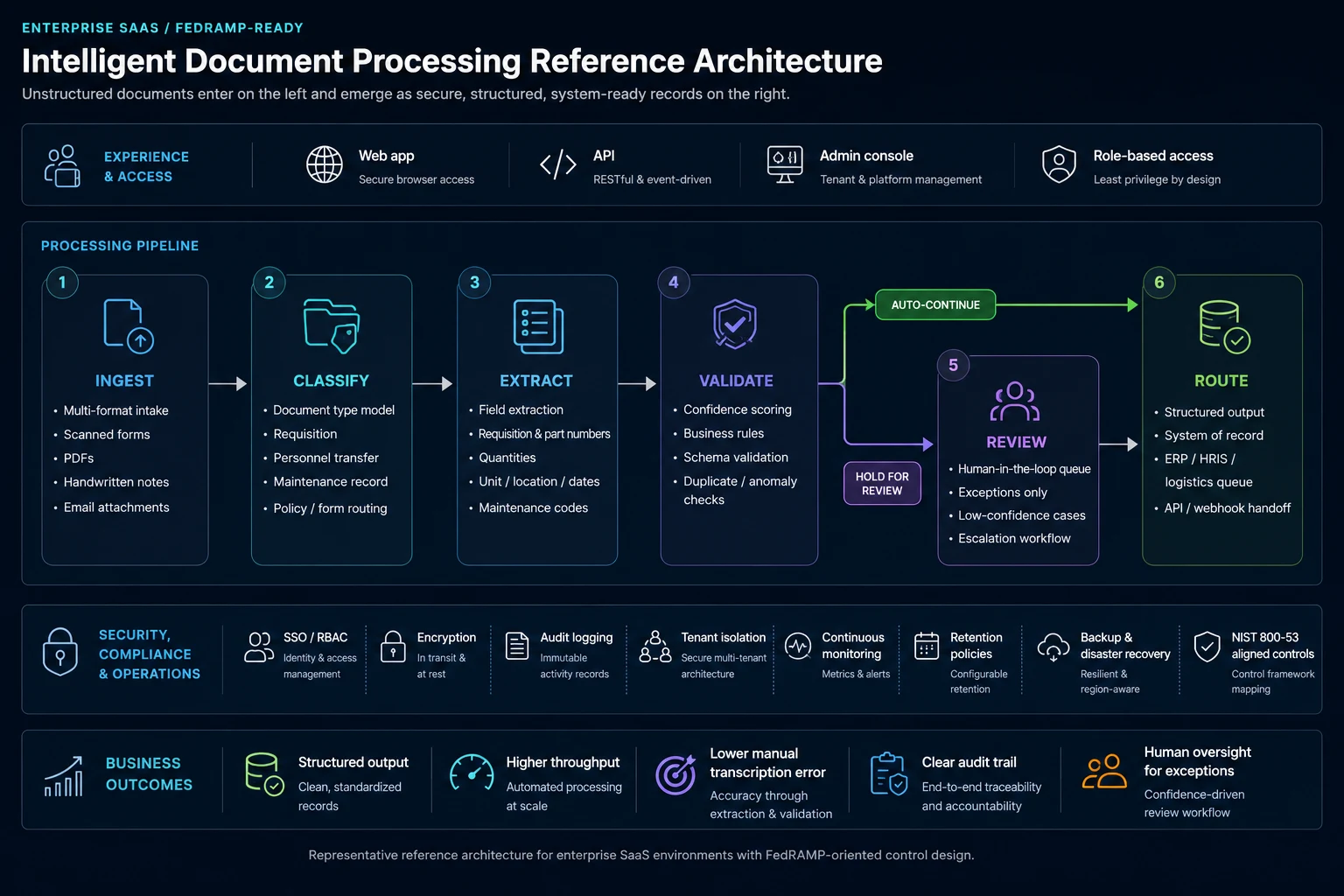
Pipeline stages & confidence gate 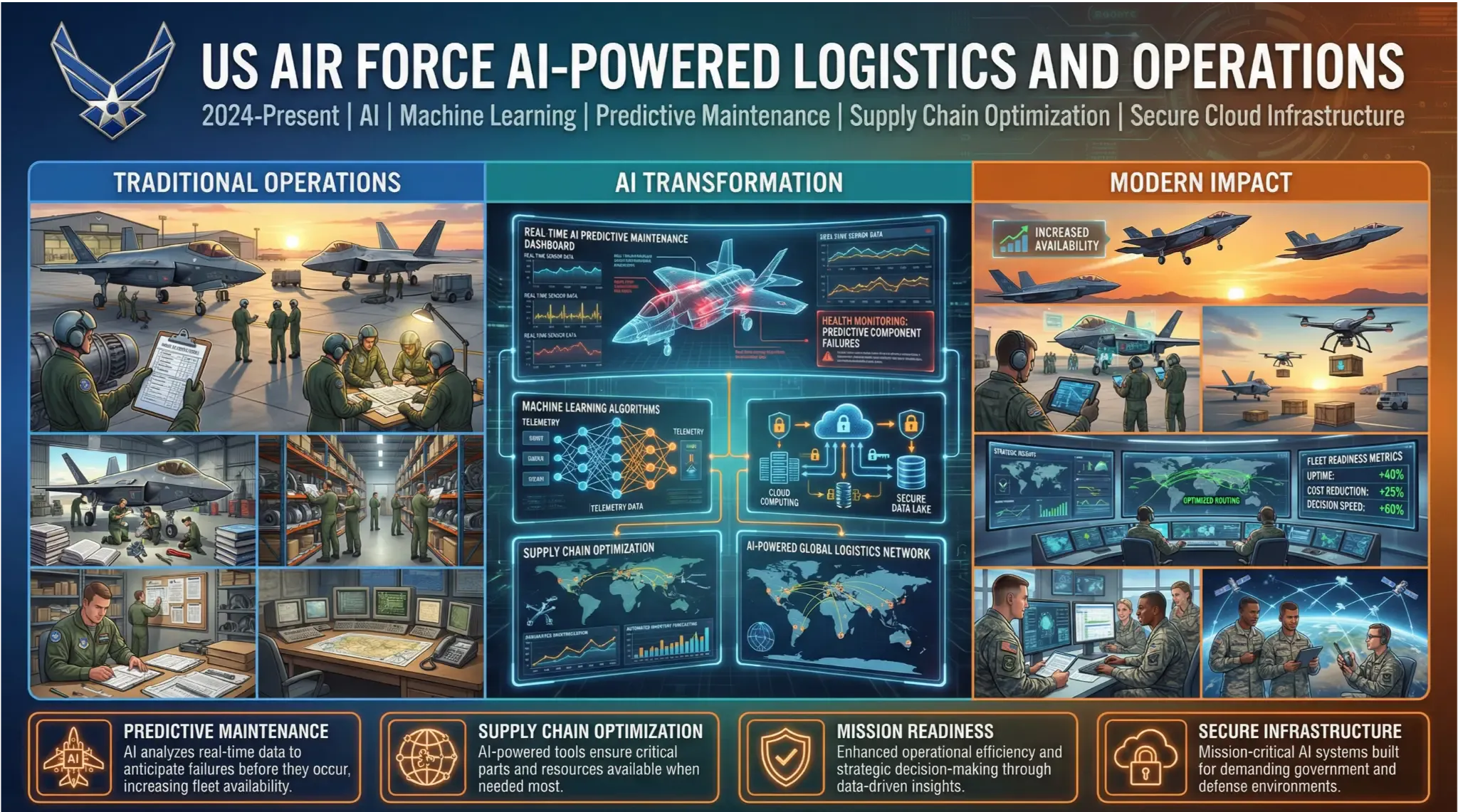
Concept visual
Results That Speak for Themselves
Applying AI to Mission-Critical Operations: Intelligent Document Processing for the U.S. Air Force
Air Force logistics documents moved through manual, human-in-the-loop processes that bottlenecked everything downstream of them. Tebeau Group developed the core AI processing engine behind an Intelligent Document Processing (IDP) platform — the models and pipeline that turn unstructured forms, PDFs, and scans into structured, system-ready data without a person transcribing each one. That engine was integrated into the broader solution delivered to the Air Force by our federal-contract partner.
Delivered as a technology subcontractor to a federal-contract holder. See “Our Role” below.
Key Outcomes
The Problem
Air Force logistics runs on paper — even when the paper is digital. Supply requisitions, personnel transfer forms, and maintenance documentation all moved through manual, human-in-the-loop processes: someone reads a form, decides what kind of document it is, keys the relevant fields into the system of record, and routes it to the next person in the chain. At the volume a logistics operation runs at, that manual handling wasn't a minor inefficiency — it was a bottleneck that slowed everything downstream of it: parts didn't move until requisitions were processed, personnel actions stalled until transfer paperwork cleared, and maintenance records lagged behind the work they were supposed to document.
The documents themselves weren't uniform. Different forms, different formats, some handwritten annotations, some scanned copies of copies — the kind of unstructured, inconsistent input that breaks simple rule-based automation and traditionally requires a person to make sense of it.
What We Built
Tebeau Group developed the core AI processing engine behind an Intelligent Document Processing (IDP) platform: the underlying models and pipeline that take unstructured documents — scanned forms, PDFs, mixed-format submissions — and turn them into structured, system-ready data without a person manually transcribing each one. That engine was integrated into the broader solution delivered to the Air Force by our federal-contract partner (see “Our Role”).
The processing engine combines several layers working together:
- Classification
- Incoming documents are automatically identified by type — a supply requisition looks different from a personnel transfer form, which looks different from a maintenance record — so each one is routed into the correct extraction and handling logic without a human presorting the queue.
- Extraction
- Machine learning models pull the specific fields that matter out of each document type — requisition numbers, part identifiers, quantities, transferring and gaining unit information, maintenance codes and dates — converting free-form or semi-structured input into clean, structured data.
- Routing
- Once a document is classified and its data extracted, the platform routes it to the right downstream system or queue automatically, instead of waiting for someone to read it and decide where it goes next.
- Validation
- Because this data feeds real logistics and personnel decisions, the system flags low-confidence extractions and edge cases for human review rather than silently guessing — automation handles the volume, people handle the judgment calls.
Why It Mattered
This wasn't a back-office paperwork project — it was infrastructure for operational tempo. Every requisition sitting in a manual processing queue is a part that isn't moving. Every personnel transfer form waiting on data entry is a service member whose records aren't current. Every maintenance form lagging behind the actual work is a gap in the documentation that readiness reporting depends on. Reducing the time and manual effort spent turning paper into data gave the Air Force logistics workflow it was applied to more throughput and fewer opportunities for transcription error, without asking anyone to change how the source documents were generated in the first place.
How We Approached It
We didn't start by picking a model. We started by mapping the actual document workflow — what forms existed, where they came from, where the manual bottlenecks actually sat, and what “correct” looked like to the people receiving the structured output on the other end. The AI is only as useful as its fit to that real workflow, so the build followed the diagnosis, not the other way around: understand where documents entered the process and where they needed to land, then design classification, extraction, and routing to fit that path — with human review built in at the points where a wrong answer would actually cost something.
Our Role
This work was not performed under a federal contract held by Tebeau Group, and Tebeau Group does not hold a facility or personnel security clearance. Tebeau Group served as a technology subcontractor to a partner company that holds the federal contract and the required clearances for this engagement; that partner company was the prime contractor of record and the party responsible for delivery to the U.S. Air Force. Tebeau Group's contribution was the underlying AI document-processing technology — the classification, extraction, and routing engine described above — which was integrated into the solution the partner company delivered.
BMAD Framework
Applied to This Project
Every Tebeau Group engagement runs through BMAD — our proprietary Breakthrough Methodology of Agile AI-Assisted Development. Here's how we applied it to US Air Force Document AI.
01 — Diagnose
Root Diagnosis Before Model Selection
We didn't start by picking a model. We mapped the actual document workflow first — what forms existed, where they came from, and where the manual bottlenecks actually sat.
02 — Specify
A Verifiable Definition of Correct
Established what 'correct' meant to the people receiving the structured output downstream, so accuracy was measured against real operational use rather than a benchmark score.
03 — Architect
Pipeline Designed to the Real Document Path
Classification, extraction, and routing were architected around how documents actually move — identify the type, pull the fields that matter, hand off to the right downstream system.
04 — Orchestrate
Automation at Volume, Humans on Judgment
Delivered with confidence thresholds that flag low-confidence extractions and edge cases for human review, so the engine scales throughput without silently guessing on decisions that carry consequences.
Scope of Work
Comprehensive solutions delivered across strategy, design, development, and marketing.
Document Classification
Incoming documents are automatically identified by type — a supply requisition looks different from a personnel transfer form, which looks different from a maintenance record — so each one is routed into the correct extraction and handling logic without a human presorting the queue. The classification layer handles unstructured, inconsistent input: different forms, different formats, handwritten annotations, and scanned copies of copies.
Field Extraction & Routing
Machine learning models pull the specific fields that matter out of each document type — requisition numbers, part identifiers, quantities, transferring and gaining unit information, maintenance codes and dates — converting free-form or semi-structured input into clean, structured data. Once a document is classified and its data extracted, it routes to the right downstream system or queue automatically, instead of waiting for someone to read it and decide where it goes next.
Human-in-the-Loop Validation
Because this data feeds real logistics and personnel decisions, the system flags low-confidence extractions and edge cases for human review rather than silently guessing. Automation handles the volume, people handle the judgment calls — with review built in at the points where a wrong answer would actually cost something.
Measurable Achievements


Project Timeline
A structured approach ensuring quality delivery and measurable results at every phase.
Discovery & Strategy
Week 1–2Stakeholder interviews, competitive analysis, and strategic roadmap development.
Design & Branding
Week 3–5Visual identity creation, brand guidelines, and design system development.
Development & QA
Week 6–10Full-stack build, quality assurance, and performance optimization.
Launch & Growth
Week 11–12Deployment, campaign launch, and ongoing performance monitoring.
Ready to Transform
Your Digital Presence?
Let's discuss how we can help you achieve similar results.
Popular Services from Tebeau Group in DFW
Popular Industries Served by Tebeau Group
Serving All DFW Cities
We Work With Businesses of Every Scale
Our Services
View all
Website Design
Conversion-focused sites built with Jobs-to-be-Done methodology.

Brand Identity
Logos, color systems, voice, and style guides that command attention.
Organic SEO
Rank higher, get found. Long-term search dominance that compounds.

AI SEO
Optimize for ChatGPT, Perplexity, and Google AI Mode — not just Google.

AI Integration
Chatbots, lead scoring, predictive analytics, and AI personalization.

Lead Generation
Own your pipeline. Stop sharing leads with competitors.

Mobile App Development
iOS & Android apps built for performance and user delight.
Custom Software
Tailored digital solutions for complex business workflows.

Ecommerce
Sell more online with high-converting storefronts and smart automation.

Strategic Discovery
Understand your goals, market, and competitive landscape before building.