The New Discovery Channel: AI as Your Referral Engine
Something fundamental has shifted in how people find businesses. A growing percentage of your potential customers are no longer typing keywords into Google and scanning results. They're asking AI assistants direct questions: "Who's the best HVAC company in Dallas?" or "Which web design agency specializes in healthcare?" — and acting on the AI's recommendation without ever seeing a search results page.
This isn't hypothetical. ChatGPT now has over 200 million weekly active users (OpenAI, 2025). Google AI Mode is available to every U.S. searcher. Perplexity processes millions of research queries daily. Together, these platforms represent a new discovery channel that operates on entirely different rules than traditional search.
The businesses that understand these rules — and optimize for them — are capturing a disproportionate share of AI referrals. The businesses that don't are watching their competitors get recommended while they remain invisible to this growing audience.
The Referral Analogy
Think of AI recommendations like a trusted friend's referral — but at scale. When ChatGPT recommends your business, it carries the same weight as a personal recommendation because the user trusts the AI's judgment. Unlike ads (which users know are paid), AI recommendations feel earned and objective. That's what makes them so powerful.
How AI Decides Who to Recommend
AI models don't recommend businesses randomly. They follow a systematic evaluation process that mirrors — but amplifies — the signals that already matter in digital marketing. Understanding this process is the key to earning consistent AI recommendations.
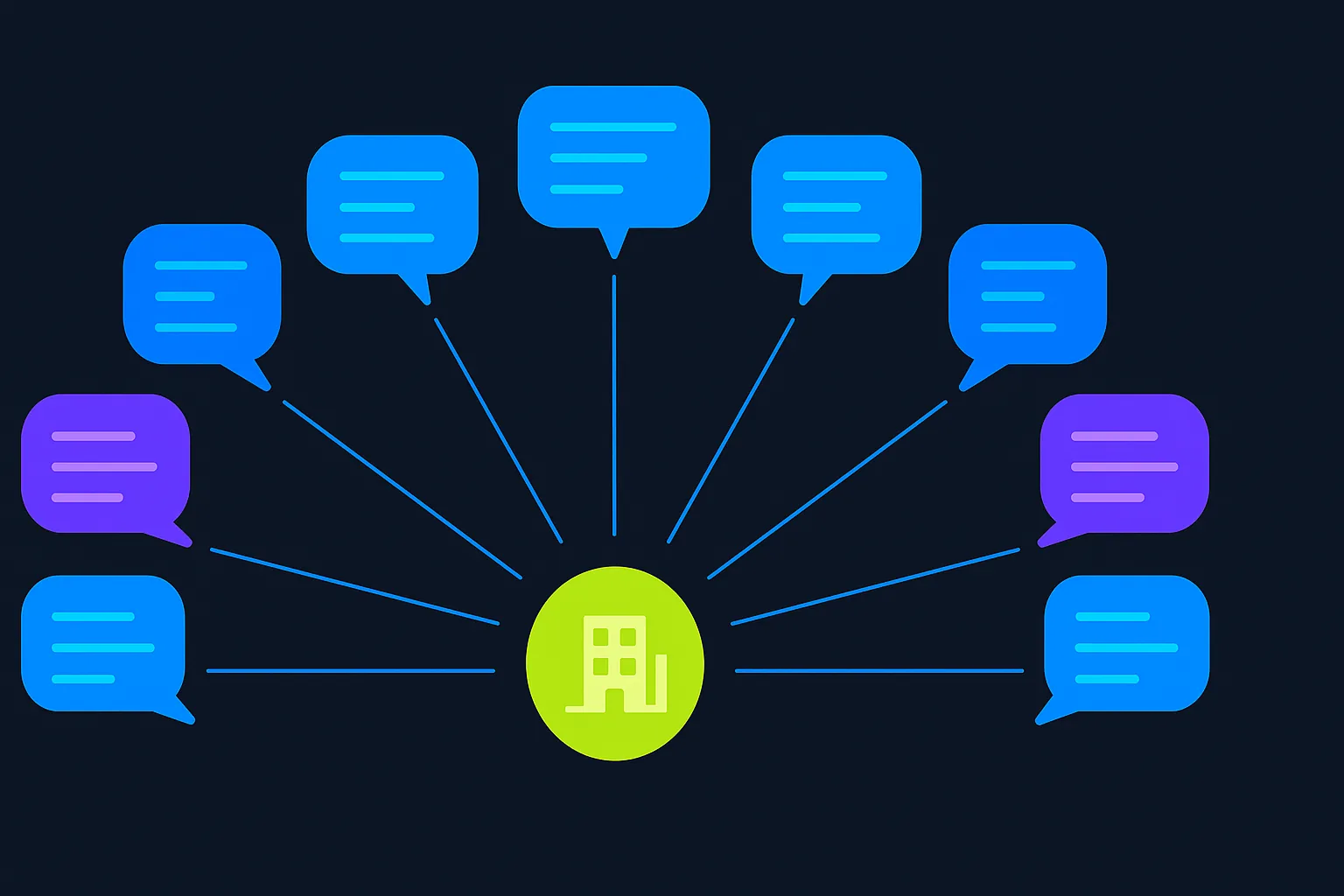
When someone asks ChatGPT or Google AI Mode for a business recommendation, the model evaluates candidates across several dimensions:
Consensus Across Sources
Is this business mentioned positively across multiple independent, authoritative sources? Reviews, news articles, industry directories, and social mentions all contribute to consensus.
Relevance to Query
Does the business's website clearly describe the exact service or product the user is asking about? Vague service pages lose to specific, detailed ones.
Authority Signals
Does the business have credentials, certifications, awards, or industry recognition? Are they cited by other authoritative sources in their field?
Recency of Information
Is the information about this business current? Outdated websites, stale reviews, and inactive social profiles signal abandonment.
Geographic Relevance
For local queries, does the business serve the area the user is asking about? NAP consistency and local citations matter enormously.
Structured Data Clarity
Can the AI easily parse what this business does, where it operates, and what makes it different? Schema markup and clear site architecture help.
The 5 Pillars of AI Recommendation
Based on our analysis of thousands of AI-generated recommendations across ChatGPT, Google AI Mode, and Perplexity, we've identified five pillars that consistently determine which businesses get cited. Master all five, and AI recommendation becomes predictable rather than random.
Review Dominance
AI models heavily weight review signals — both quantity and quality. A business with 200+ Google reviews averaging 4.7 stars will consistently outrank a competitor with 30 reviews at 4.9 stars. The volume signals market validation. Respond to every review (positive and negative) — AI models can see your response patterns and factor them into trust assessments.
Action Step
Get to 100+ Google reviews with a 4.5+ average. Respond to every review within 48 hours. Diversify reviews across Yelp, BBB, and industry-specific platforms.
Content Authority
Your website needs to demonstrate deep expertise in your field — not through keyword-stuffed blog posts, but through genuinely useful, comprehensive content that answers the exact questions your customers ask. AI models evaluate whether your content provides unique value that can't be found elsewhere.
Action Step
Publish 2-4 long-form articles monthly (1,500+ words). Cover your service area comprehensively. Include original data, case studies, and expert perspectives that competitors don't have.
Web Presence Breadth
AI models cross-reference information across the entire web. If your business only exists on your own website, you're invisible to AI. You need consistent mentions across directories, industry publications, local news, social platforms, and professional networks. Each mention is a vote of confidence.
Action Step
Claim and optimize 20+ directory listings. Get mentioned in 3+ industry publications. Maintain active profiles on LinkedIn, Google Business Profile, and relevant social platforms.
Trust Infrastructure
Certifications, awards, partnerships, and credentials are trust signals that AI models weigh heavily. They're objective, verifiable markers that separate legitimate businesses from fly-by-night operations. Display them prominently on your website with proper schema markup so AI can parse them.
Action Step
List all certifications and licenses with schema markup. Apply for industry awards. Establish partnerships with recognized organizations. Display BBB accreditation, industry memberships, and insurance credentials.
Structured Clarity
AI models need to understand exactly what you do, where you do it, and who you do it for. Ambiguous service pages, missing location information, and unclear specializations make it impossible for AI to confidently recommend you. Structure your website so a machine can parse your value proposition in seconds.
Action Step
Implement LocalBusiness, Service, and Organization schema. Create dedicated pages for each service and location. Use clear, specific H1 tags that match natural language queries.
Platform-Specific Strategies
While the five pillars apply universally, each AI platform has unique characteristics that influence how it selects businesses to recommend. Here's how to optimize for each:
ChatGPT
- Ensure your business appears on high-authority review and directory sites that ChatGPT's web search accesses
- Write content in clear, quotable sentences — ChatGPT prefers to cite concise, authoritative statements
- Maintain an active, professional presence on platforms ChatGPT indexes (LinkedIn, industry forums, news sites)
- Ask satisfied clients how they found you — if they say 'ChatGPT recommended you,' document the prompt for optimization insights
Google AI Mode
- Optimize your Google Business Profile completely — AI Mode pulls heavily from GBP data for local recommendations
- Rank in the top 20 organic results for your target queries (97% of AI Mode citations come from there)
- Implement comprehensive schema markup — Google's AI uses structured data to understand your business
- Build local citation consistency — AI Mode cross-references your NAP data across the web
Perplexity
- Perplexity heavily cites sources with clear, factual content — avoid marketing fluff and write substantively
- Get mentioned in industry publications and news articles — Perplexity weights editorial sources highly
- Structure content with clear headings and concise answers — Perplexity extracts specific passages for citations
- Publish original research and data — Perplexity preferentially cites primary sources over aggregators
Measuring Your AI Visibility
You can't improve what you don't measure. Here's how to track whether AI platforms are recommending your business — and how to benchmark against competitors:
Manual Testing
Ask ChatGPT, Perplexity, and Google AI Mode your target queries weekly. Document which businesses get recommended and what language the AI uses to describe them. Note whether you appear and in what position.
LLM Referral Tracking
Check your analytics for traffic from ai.chatgpt.com, perplexity.ai, and other AI referral sources. Set up UTM-tagged landing pages and monitor which AI platforms send traffic.
AI Rank Tracking Tools
Use BrightEdge, Search Atlas, or Conductor to automatically monitor your appearance in AI Overviews and AI Mode results across hundreds of keywords.
Competitor Benchmarking
Run the same AI queries for your competitors. Document their citation frequency, the sources AI pulls from, and what differentiates their presence from yours.
Common Mistakes to Avoid
Many businesses attempt to optimize for AI recommendations but undermine their own efforts with these common mistakes:
Treating AI optimization as separate from SEO
Fix: AI recommendations are built on top of strong SEO fundamentals. You need both — not one or the other. 97% of AI citations come from pages already ranking in the top 20.
Publishing thin, keyword-stuffed content
Fix: AI models can detect low-quality content instantly. They prefer comprehensive, genuinely useful content with original insights. One 2,000-word authoritative article outperforms ten 300-word keyword-targeted posts.
Ignoring review management
Fix: Reviews are the single strongest signal for local AI recommendations. A business with 50 unresponded reviews signals neglect. Respond to every review and actively solicit new ones.
Inconsistent business information across the web
Fix: If your address, phone number, or business name varies across directories, AI models lose confidence in your data. Audit and standardize your NAP information everywhere.
Waiting for AI search to 'mature' before acting
Fix: AI search is mature now. ChatGPT has 200M+ weekly users. Google AI Mode is live for all U.S. users. Every week you wait is a week your competitors build AI authority that compounds over time.
Frequently Asked Questions
How does ChatGPT decide which businesses to recommend?
ChatGPT recommends businesses based on the information available in its training data and real-time web search results. It prioritizes businesses with strong online presence across multiple authoritative sources — including review platforms, industry directories, news mentions, and well-structured websites with clear service descriptions and expertise signals.
Can I pay to get recommended by ChatGPT?
No, you cannot directly pay ChatGPT or OpenAI to recommend your business. AI recommendations are based on the quality, authority, and relevance of your online presence. However, you can invest in building the signals that AI models use to evaluate trustworthiness — strong reviews, authoritative content, structured data, and consistent NAP information across the web.
How long does it take to start appearing in AI recommendations?
Most businesses see initial improvements in AI citations within 4-8 weeks of implementing a comprehensive AI search optimization strategy. However, building the authority signals that consistently earn AI recommendations is an ongoing process. Businesses with existing strong SEO foundations will see faster results than those starting from scratch.
Does Google AI Mode recommend local businesses?
Yes, Google AI Mode actively recommends local businesses, especially for service-based queries. It pulls from Google Business Profile data, local review signals, and structured website content. Local businesses with complete GBP profiles, strong reviews, and well-optimized websites are significantly more likely to be cited in AI Mode's local recommendations.
Is AI Recommending Your Competitors Instead of You?
Right now, someone is asking ChatGPT who to hire for exactly what you do. Are you the answer — or is your competitor? Get a free AI visibility audit from Tebeau Group. We'll show you exactly what AI says about your business today and build a strategy to make you the recommended choice. Also see our guide to the best AI SEO tools and our AI chatbot built specifically for home service businesses.